.jpg)
Engineering Safety: Why 10 PSI Rated Blast Resistant Modules are Essential for Remote Infrastructure

In oil and gas extraction, chemical processing, and infrastructure development within high-risk regions, "Safety" is never an option—it is the foundation. As global demand for modular construction surges, Blast Resistant Modules (BRM) have emerged as the premier solution for protecting both critical assets and human life.
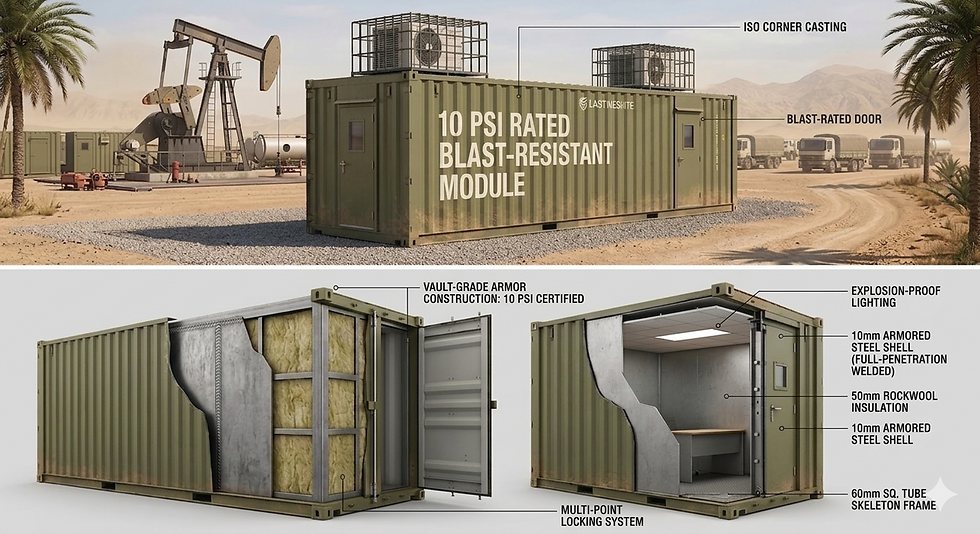
1. The Core of Defense: 10mm High-Tensile Steel Shell
Traditional modified containers often fail to withstand the intense pressure of a real-world explosion. Our BRM series features an independent, self-supporting 10mm high-tensile steel armor shell. Unlike standard 5mm plates or composite panels found elsewhere, our 10mm full-penetration welded structure ensures the module remains intact under blast overpressures of up to 10 PSI, preventing catastrophic structural failure and internal spalling.
2. Beyond Blast Resistance: Desert-Optimized Engineering
For projects in extreme climates like Saudi Arabia or Iraq, a module must be as heat-resistant as it is blast-resistant.
Dual-Circuit Industrial HVAC: Equipped with redundant cooling systems to ensure 24/7 stability for internal electronics (such as server racks) in ambient temperatures exceeding 50°C.
Advanced Sand-Filtration: Specialized protective cages and filtration systems prevent fine desert dust from compromising sensitive equipment and air quality.
3. Versatility Across Sectors: Data Centers to Medical Clinics
Modern Blast Resistant Modules are no longer just simple bunkers. Through flexible internal customization, they serve as vital infrastructure hubs:
Modular Data Centers (MDC): Providing a hardened, secure IT environment for remote oilfields.
Off-Grid Command Centers: Integrating satellite communications and solar power arrays to act as a centralized hub in unmapped territories.
Emergency Medical Clinics: Offering protected medical spaces with negative pressure ventilation for high-risk zones.
4. Rapid Deployment: The "Plug-and-Play" Advantage
In large-scale engineering, time is a critical cost factor. Our modules are designed to standard ISO container dimensions, allowing them to be shipped via conventional sea freight to any global port and positioned using standard cranes. Once on-site, they are truly "plug-and-play," requiring zero on-site construction and providing immediate operational readiness.
Conclusion
Investing in high-specification Blast Resistant Modules is more than a compliance measure—it is a strategic decision to ensure continuity during a crisis. If you are planning infrastructure in high-risk environments, choosing a solution with 10 PSI certification and a 10mm steel core is the most reliable engineering choice you can make.

