.jpg)
Designing for the Blast Zone: A Complete Guide to Blast-Resistant Modules (BRMs) and Field Extensions

In high-risk sectors like oil and gas extraction, chemical refining, mining operations, and defense, structural resilience is not an option—it is a regulatory and operational baseline. When vapor cloud explosions (VCEs) or sudden overpressure events occur, standard site architecture fails catastrophically.
This is where Blast-Resistant Modules (BRMs) step in. Engineered to withstand intense shockwaves and shrapnel impact, these modular structures have evolved far beyond basic survival shelters. Today, they serve as the operational backbone for hazardous environments worldwide, offering unprecedented flexibility and turn-key deployment.
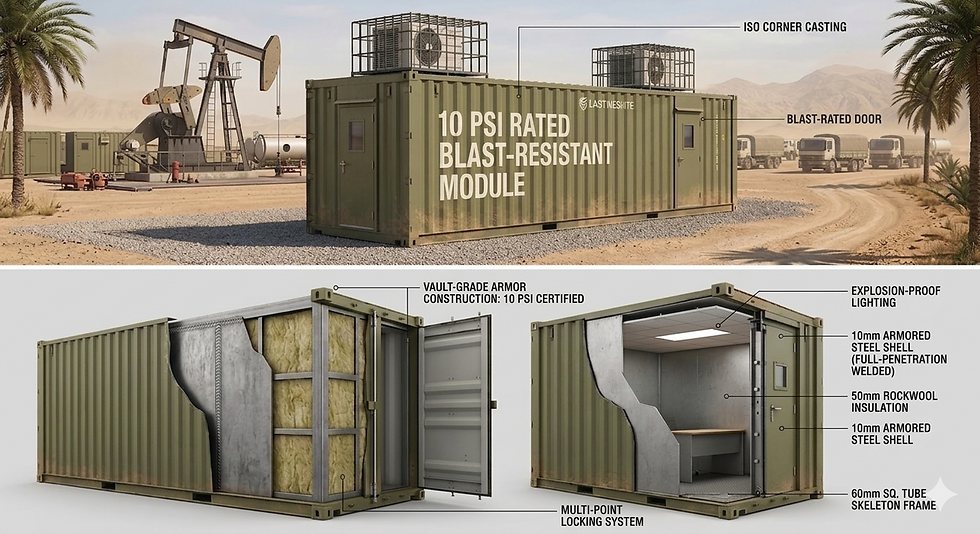
Engineering Foundations: What Validates a True BRM?
A genuine blast-resistant container is fundamentally different from a standard shipping container reinforced with thicker steel plates. It is a highly engineered structure governed by dynamic structural analysis. Industry-leading BRMs are defined by specific technical benchmarks:
Overpressure Ratings (PSI): Structures are dynamically modeled to withstand specific peak overpressure levels—typically ranging from 5 PSI, 8 PSI, up to 10 PSI—with varying blast durations.
Thermal Barriers and Hermetic Sealing: Blast protection must be paired with fire safety. Premium modules feature strict structural fire ratings (such as A60 insulation) alongside airtight seals and positive-pressure ventilation systems (PPVS) to keep toxic or flammable gases out.
Weight Optimization: Leveraging advanced high-tensile steel allows for maximum structural integrity without adding unnecessary dead weight. This crucial engineering balance lowers logistics overhead during ocean freight and simplifies crane handling in remote, off-grid locations.
Multi-Functional Extensions: Transforming the Blast Shell
The true value of a modern BRM lies in its adaptability. By merging a hardened exterior with architectural-grade interior engineering, these modules can be customized into dedicated, mission-critical environments within the impact zone:
1. Blast-Resistant Field Offices & Main Control Rooms (MCR)
Application: Positioned directly adjacent to onshore refining units, offshore drilling derricks, or mining blast perimeters.
Functional Setup: These units are outfitted with shock-isolated server racks, uninterruptible power supplies (UPS), multi-screen monitoring consoles, and reinforced cable transit seals. If an industrial incident triggers an explosion, the control room remains online, allowing operators to execute emergency shutdown protocols safely.
2. Satellite Briefing Rooms & Living Quarters (BRMs for Camps)
Application: Remote base camps and exploration sites where crew members live and work within potential hazard radii.
Functional Setup: Hardened modules can be joined seamlessly on-site to build spacious conference rooms, multi-bunk sleeper units, and mess halls. Equipped with vibration-dampened interior walls, climate-controlled HVAC filtration, and recessed lighting, they offer a secure and comfortable refuge chamber for field personnel.
3. Intelligent Hazardous Material & Chemical Storage
Application: Secure, on-site storage for volatile chemicals, laboratory reagents, or volatile munitions at chemical plants and defense installations.
Functional Setup: The interior is upgraded with explosion-proof lighting, spark-resistant HVAC systems, automated gas suppression mechanisms (such as FM-200), anti-static flooring, and built-in secondary containment bunds to catch hazardous leaks or spills.
4. Mobile Equipment Enclosures & Power Skids
Application: Protecting high-voltage generators, switchgears, critical analytical instrumentation, and remote telecommunication hubs.
Functional Setup: Features custom heavy-duty skids, structural lifting points, and automated blast dampers on air intakes that instantly slam shut during a blast wave to stop thermal energy from penetrating the core equipment.
Q1: How do project engineers determine the correct PSI rating for a site BRM?
A: Selection must align directly with the facility’s Quantitative Risk Assessment (QRA) report. Safety auditors calculate potential vapor cloud volume, proximity to ignition sources, and structural congestion to determine the peak overpressure wave that could hit a specific location. Modules are then custom-engineered to handle anywhere from 1 to 10+ PSI to match those exact safety parameters.
Q2: Can blast-resistant modules be relocated, or are they permanent fixtures?
A: They are built for extreme mobility. Standard modules utilize standard ISO dimensions (20-foot and 40-foot variants) and feature heavy-duty corner castings. This allows them to be shipped via standard cargo liners and flatbed trailers. Once a project phase wraps up, the entire unit can be disconnected, crane-lifted, and moved to the next site, keeping capital equipment utilization exceptionally high.
Q3: How do blast-resistant interiors protect occupants from secondary blast injuries?
A: True blast mitigation goes beyond the outer shell. Structural deflection during an explosion can turn loose items into dangerous projectiles. Professional BRM interiors utilize non-rigid, flexible mounting systems for all furniture, light fixtures, and ductwork. Cabinets feature heavy-duty mechanical latches to ensure that even during violent structural displacement, the interior remains secure and free from secondary impact hazards.

